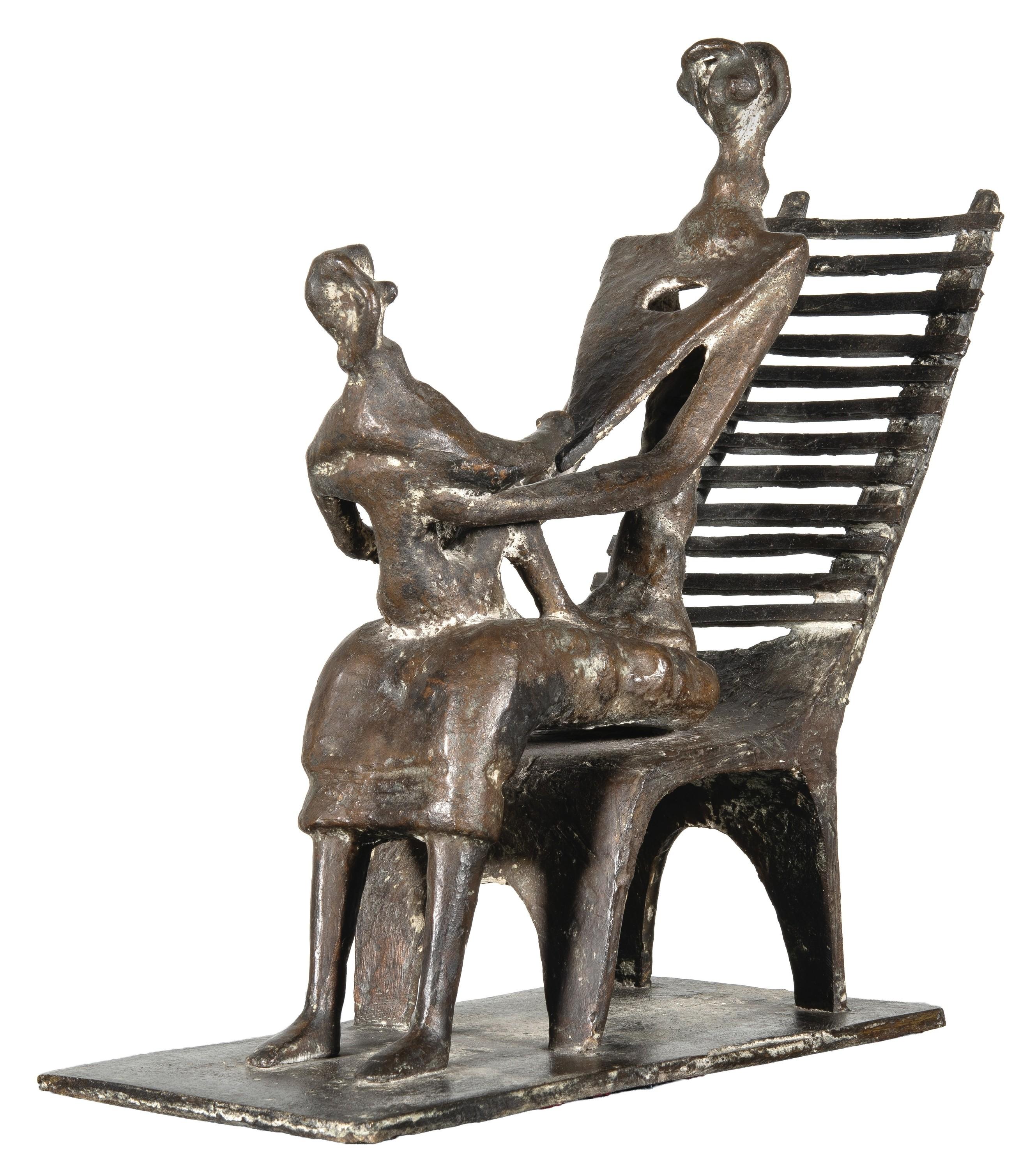
Henry Moore (* 30 July 1898 in Castleford, Yorkshire; † 31 August 1986 in Perry Green, Hertfordshire) is considered one of the most important British sculptors of the 20th century. The human figure is at the centre of his work, represented in forms ranging from the naturalistic to the abstract. His monumental sculptures in particular had a significant influence on European post-war sculpture.
Education
Henry Moore was born on 30 July 1898 in Castleford, Yorkshire. From an early age, he wanted to become a sculptor. Initially, however, he followed his father’s wishes and trained as a teacher. After completing his training, he began working as a junior teacher at his former school in Castleford in 1915. In 1916, Moore joined the British Army and served in the First World War. In 1919, as a former serviceman, he received a grant and began studying at Leeds College of Art. In 1920, he became the college’s first full-time sculpture student and met the sculptor Barbara Hepworth, with whom he formed a lifelong friendship.
In 1921, Moore was awarded a scholarship to the Royal College of Art and moved to London. Alongside his studies, he devoted considerable attention to the collections of the British Museum and particularly to non-Western sculpture. After completing his studies, he began teaching at the Royal College of Art in 1925.
London and the Avant-Garde
In 1928, Moore held his first solo exhibition at the Warren Gallery in London. The following year, he married Irina Radetzky. During this period, Moore increasingly developed his own sculptural language. The human figure remained his central subject, with the reclining figure in particular becoming a recurring motif throughout his career. His sculptures became increasingly abstract and were frequently characterised by openings and hollow spaces.
In 1930, Moore exhibited in the British Pavilion at the Venice Biennale and joined the Seven and Five Society. From 1932 to 1939, he headed the sculpture department at the Chelsea School of Art. During the 1930s, he engaged intensively with abstract and Surrealist ideas and came into contact with the European avant-garde. In 1934, he exhibited with the artists’ group Unit One, and in 1936 he participated in the International Surrealist Exhibition in London.
War Years
Following damage to his London studio during an air raid, Henry and Irina Moore moved to Perry Green in Hertfordshire in 1940, which became their permanent home and workplace. During the bombing of London, Moore observed people sheltering in London Underground stations. These experiences inspired his so-called Shelter Drawings. In 1941, Moore was appointed an official war artist. During the war, he initially concentrated primarily on drawing before returning more intensively to sculpture in 1943. In the same year, his first solo exhibition outside Britain was held at the Buchholz Gallery in New York.
International Breakthrough
Following the Second World War, Moore’s international reputation grew considerably. In 1946, the Museum of Modern Art in New York presented a major retrospective of his work. Two years later, Moore was awarded the International Prize for Sculpture at the Venice Biennale. Numerous exhibitions, major public commissions and awards followed, as well as honorary degrees from distinguished universities.
In 1951, the Tate Gallery in London presented a major retrospective of his work. Among his most important public commissions is the monumental UNESCO Reclining Figure, installed outside UNESCO’s headquarters in Paris in 1958. In 1965, a monumental Reclining Figure followed for the Lincoln Center for the Performing Arts in New York. Moore’s combination of figuration and abstraction established him as one of the most internationally influential sculptors of his time.
Later Years
In 1963, Moore was awarded the British Order of Merit. To mark his 70th birthday, the Tate Gallery organised another major retrospective in 1968. This was followed in 1972 by an extensive exhibition at the Forte di Belvedere in Florence. In 1974, following a substantial donation by the artist, the Henry Moore Centre opened at the Art Gallery of Ontario in Toronto.
In 1977, Moore and his family established the Henry Moore Foundation to promote the visual arts, and sculpture in particular, and to preserve his artistic legacy. Moore continued to work into old age and was honoured with numerous international exhibitions. Henry Moore died on 31 August 1986 at the age of 88 at his home in Perry Green, Hertfordshire.