Provenance:
Artist’s studio
Dora Ritschl, Wiesbaden (1934)
Stuttgarter Kunstkabinett (auction 1959, cat. 34, lot 302 [as “Konstruktiver Kopf”], ill. pl. 117)
Lempertz, Cologne (auction 1968, cat. 499, lot 354, ill. pl. 3)
Galerie Wilhelm Grosshennig, Düsseldorf (1968/69)
Wolfgang Ketterer, Munich (auction 1970, cat. no. 3, lot 624, colour ill. pl. 137)
Private collection, Germany
Exhibitions/Literature:
Clemens Weiler: Alexej Jawlensky, Cologne 1959, no. 379, ill. p. 254
Deutsche und französische Meisterwerke des 20. Jahrhunderts, Galerie Wilhelm Grosshennig, Düsseldorf 1968/69, ill. p. 77
“In Wiesbaden, for several years I painted only my large Abstract Heads. I was so concentrated on these works and wanted to achieve a completely spiritual content. In this way, very good works came into being.”
(Alexej von Jawlensky, Memoirs)
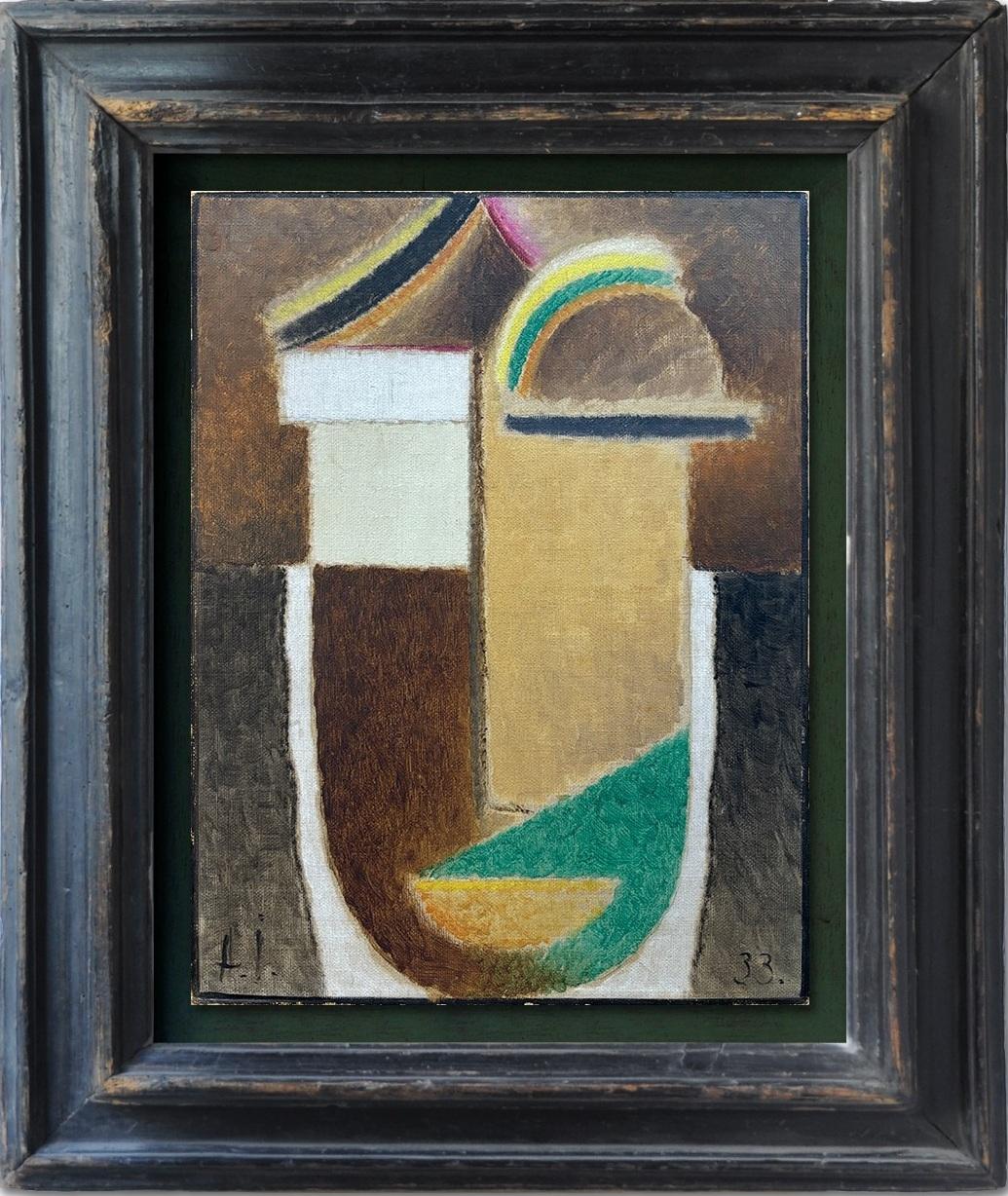
The “Abstrakter Kopf” (Abstract Head), painted in 1933, belongs to the group of works that lies at the heart of Alexej von Jawlensky’s Wiesbaden period.
The “Abstract Heads” can be understood as a form of modern religious icon. They are images intended for contemplative viewing. In this series, on which he worked from 1918 to 1935, Jawlensky moved away from the natural model, transforming the human face into a fixed, geometrically ordered system of signs. This departure from individual portraiture was accompanied by an increasing focus on repetition, variation and inner order. The artist developed a fixed compositional scheme, which he repeatedly revitalised through an almost inexhaustible variety of colour harmonies.
The large-format “Abstrakter Kopf” of 1933 follows this reduced formal vocabulary. The cheeks and chin are contained within a broad, pale U-shape that sets the face apart from the dark background. Within it, large areas of colour structure the face: a deep brown on the left is set against a warm ochre on the right, while a green area completes the composition in the lower section. The mouth appears as a yellow-ochre area within the green lower half of the face.
The facial features are reduced to a small number of abstract signs. A vertical axis denotes the nose, while horizontal and curved lines mark the eye area. In the upper right half of the face, green, yellow and violet arcs follow one another. Dark and coloured lines define the upper edge of the forehead and suggest an abstracted hairline. The face is thus constructed not through modelled forms, but through the arrangement of lines and clearly delineated areas of colour.
Brown and ochre tones dominate large parts of the painting and are complemented by green, yellow and violet. Areas of white stand out clearly from the coloured fields, while black lines articulate and define the forms. Despite the high degree of abstraction, the basic form of the human face remains recognisable. The face appears not as an individual portrait, but as a universal form developed through colour, line and plane.
On the reverse, the painting bears the personal dedication ‘Für Frau Dora Ritschl mit Verehrung’ (‘For Mrs Dora Ritschl, with admiration’), together with Jawlensky’s signature and the date 1934. That same year, Jawlensky gave the work to Dorothea ‘Dora’ Ritschl, wife of the Wiesbaden painter Otto Ritschl, with whom he shared a close artistic friendship. The painting remained in Dora Ritschl’s possession until her death in 1958.