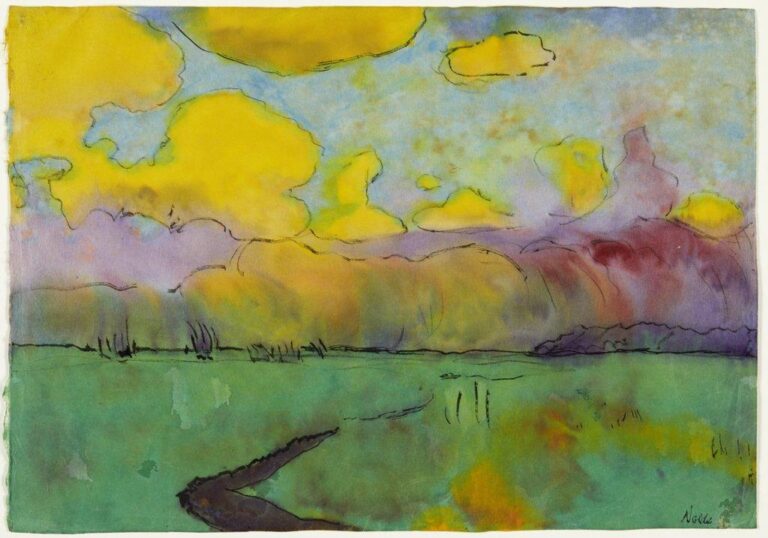
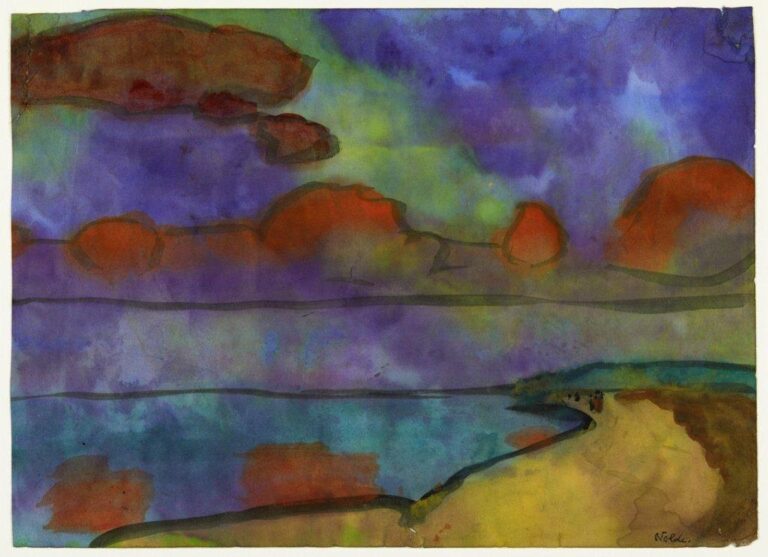
Emil Nolde is regarded as one of the most important watercolourists of the 20th century and a central figure of German Expressionism. His virtuosity is evident both in his painterly technique and in his distinctive handling of colour. For Nolde, colour is the primary structural element: it determines not only form and subject matter, but also atmosphere, light and movement.
Emerging directly from the act of painting, Nolde developed his works through free chromatic flows and the spontaneous circumstances of the moment. The creative process remains visible within the image, lending his watercolours their characteristic immediacy.
The Sea as a Central Motif
The sea occupies a central position in Nolde’s oeuvre and appears in numerous variations. Raised in the German-Danish border region of Schleswig-Holstein between the North Sea and the Baltic Sea, Nolde was familiar from childhood with the elemental force of the ocean. This early experience profoundly shaped his artistic vision.
In his marine watercolours, Nolde utilised the spontaneity of the medium to create atmospheric compositions of light and colour. Often, it is not only the sea itself but above all the sky that becomes the true protagonist of the scene.
Composition and Chromatic Drama
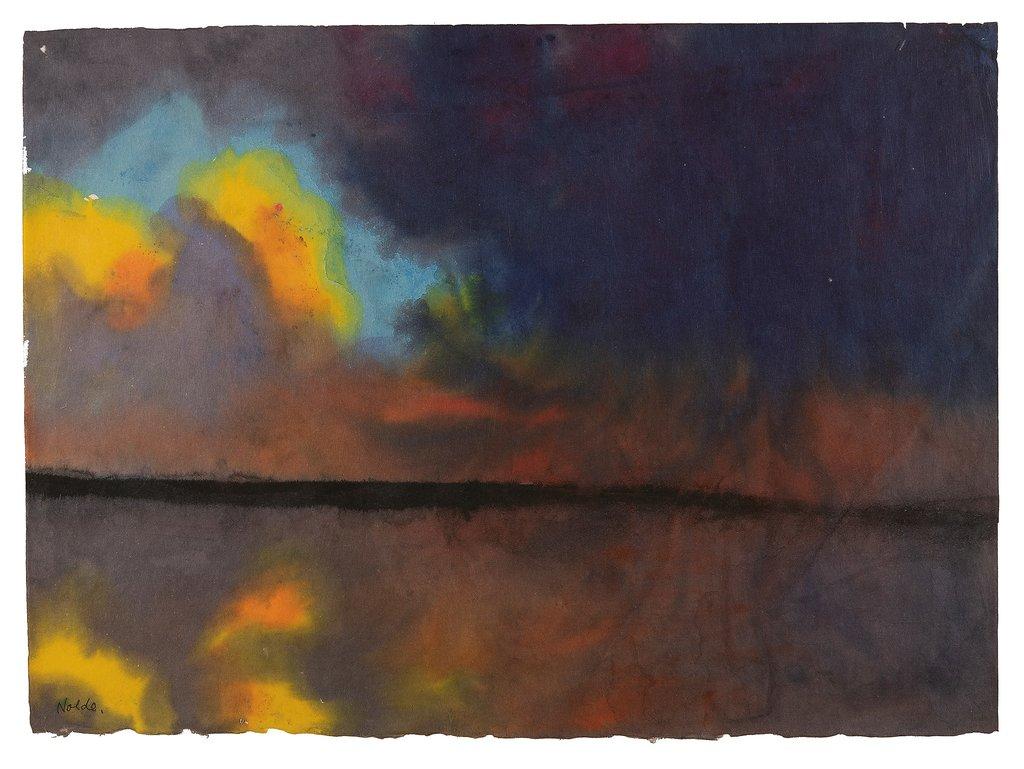
The watercolour Dunkle See mit Wolkenspiegelung (Dark Sea with Reflection of Clouds) presents an expansive seascape beneath a dramatically darkened sky. A nearly horizontal line marks the horizon, dividing the composition into two zones: the cloud-filled sky above and the calm water surface below.
Deep blues and violets dominate the sky, overlaid by dense, cloud-like colour fields. On the left, luminous yellow and orange passages emerge as breaks in the cloud cover, suggesting shafts of light. These intense accents are echoed in the reflective surface of the water, visually connecting the two halves of the composition.
The lower area is rendered in more subdued transitions of grey, brown and blue tones, creating a heavy, atmospherically charged mood in which sea and sky almost merge.
Technique and Painterly Freedom
The painting is characterised by soft tonal transitions, translucent layers and deliberately permitted colour blends. Nolde worked without preparatory drawing and frequently painted on absorbent Japanese paper, often employing a wet-on-wet technique. The brush leaves minimal trace; the transitions appear fluid and mist-like.
Irregularities in the application of colour and visible edges of washes emphasise the immediacy of the medium and preserve the presence of the creative act within the image.
From around 1918 onwards, landscapes increasingly entered Nolde’s watercolour practice, although precise dating — as in the case of Dunkle See mit Wolkenspiegelung — is rarely possible. Here, sea and sky coalesce into an almost abstract vision: not a topographical location, but an intense and immersive experience of nature, light and atmosphere.