Catalogue raisonné: Göpel 628
Provenance:
The artist’s studio
Erhard Göpel Collection, Berlin/Munich (acquired from the artist in 1943)
Kunstverein Düsseldorf (acquired in 1950)
Bayer AG, Leverkusen (acquired from the previous owner in 1951)
Max Beckmann – Orchideen-Stillleben mit grüner Schale (1943)
Max Beckmann’s years of exile in Amsterdam rank among the most productive phases of his artistic career, despite severely restricted opportunities to exhibit and work. Following his emigration from Germany in 1937—precipitated by the denunciation of his art as “degenerate”, the loss of his teaching post in Frankfurt, and his exclusion from official exhibitions—Beckmann developed a renewed artistic focus during his Dutch exile.
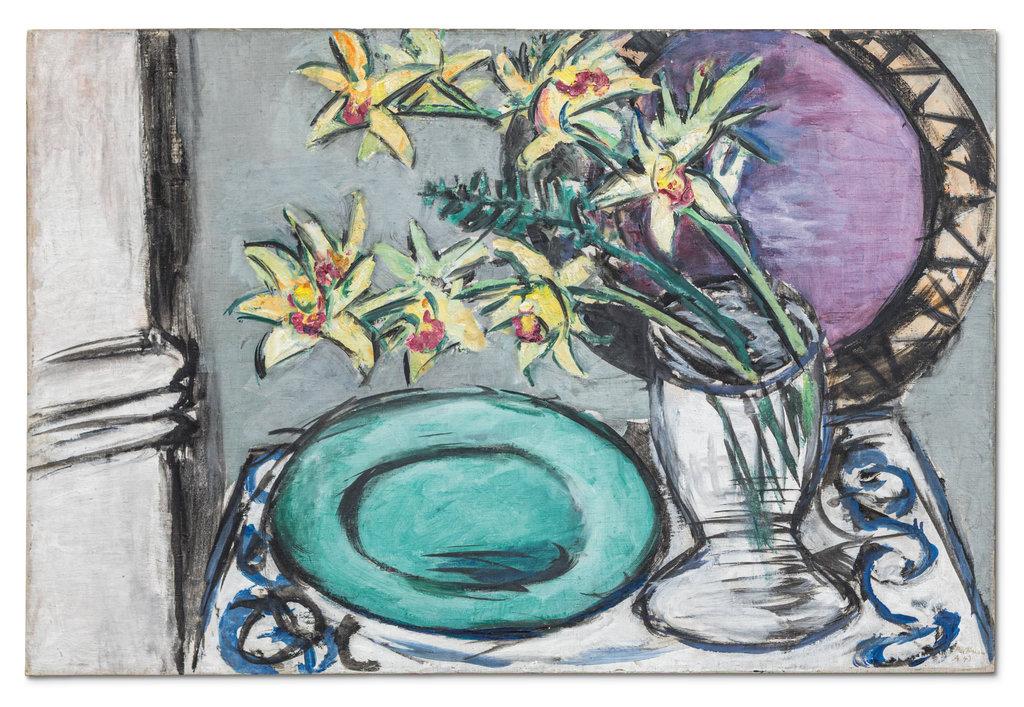
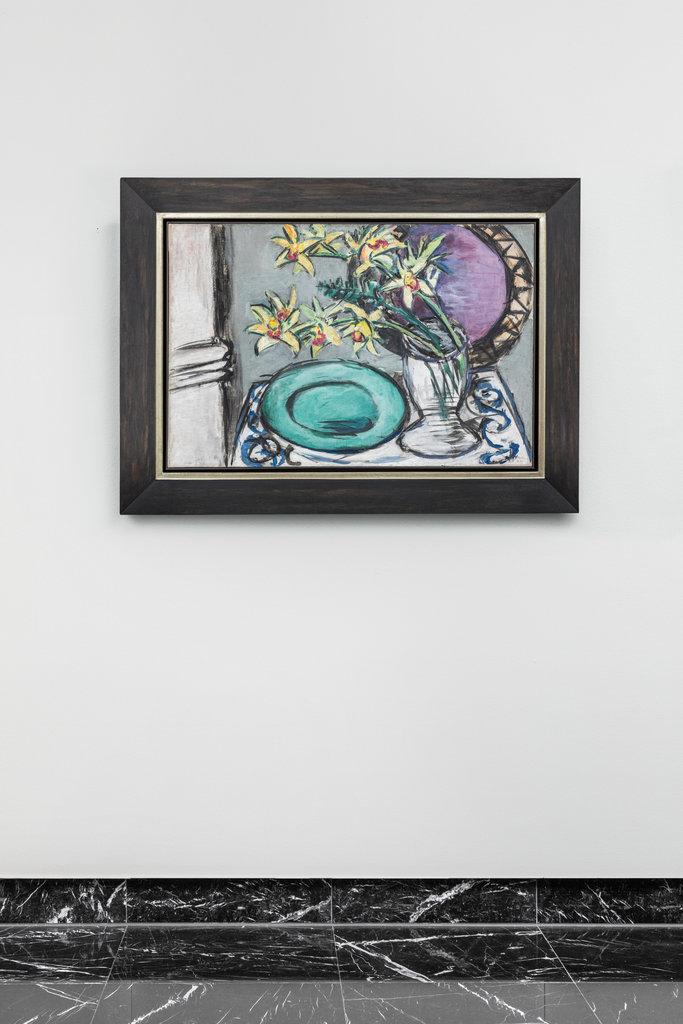
During this period, the still life assumed increasing importance within Beckmann’s oeuvre. Painted in 1943, Orchideen-Stillleben mit grüner Schale (Orchid Still Life with Green Bowl) is considered one of the principal works of this phase and stands as a compelling example of Beckmann’s painterly concentration of form, colour and space.
Composition and Pictorial Language
Like his figure paintings, this still life adheres to Beckmann’s characteristic formal principles. Bold black contours structure the composition: a vase of radiant orchids and a striking green bowl are arranged on a table draped with cloth.
The blossoms, extending emphatically to the left, determine the dynamic movement of the image, while a large mirror in the background—devoid of any actual reflection—functions as an independent, chromatically distinct pictorial field. The intense yellows and reds of the orchids contrast with the cooler green and blue-violet tones of the bowl, mirror and wall.
The green bowl forms a calm centre within the composition, set in deliberate tension against the asymmetrically arranged flowers, which appear subtly off balance. The result is an equilibrium between stability and movement—an essential compositional principle in Beckmann’s mature work.
Context of Creation and Personal Dedication
The circumstances surrounding the painting’s creation are exceptionally well documented. On 12 February 1942, his 58th birthday, Beckmann received a green bowl and flowers as a gift from his wife, Quappi. On 1 February 1943 he conceived the still life with the green bowl, and on 5 February 1943—his wife’s birthday—he recorded his work on the painting in his diary.
This personal dimension lends the work additional biographical depth within the context of Beckmann’s years in exile.
Provenance and Art Historical Significance
The painting’s provenance further underscores its art historical importance. It was acquired by Erhard Göpel, a close confidant and one of Beckmann’s most significant advocates. In 1951 it entered the collection of Bayer AG—an exceptionally early institutional acquisition, particularly at a time when post-war European discourse was increasingly shifting towards abstraction.
The painting thus stands not only as an exemplary still life from Beckmann’s 1940s production, but also as evidence of the early institutional recognition of his work in Germany.