Provenance: The artist’s studio
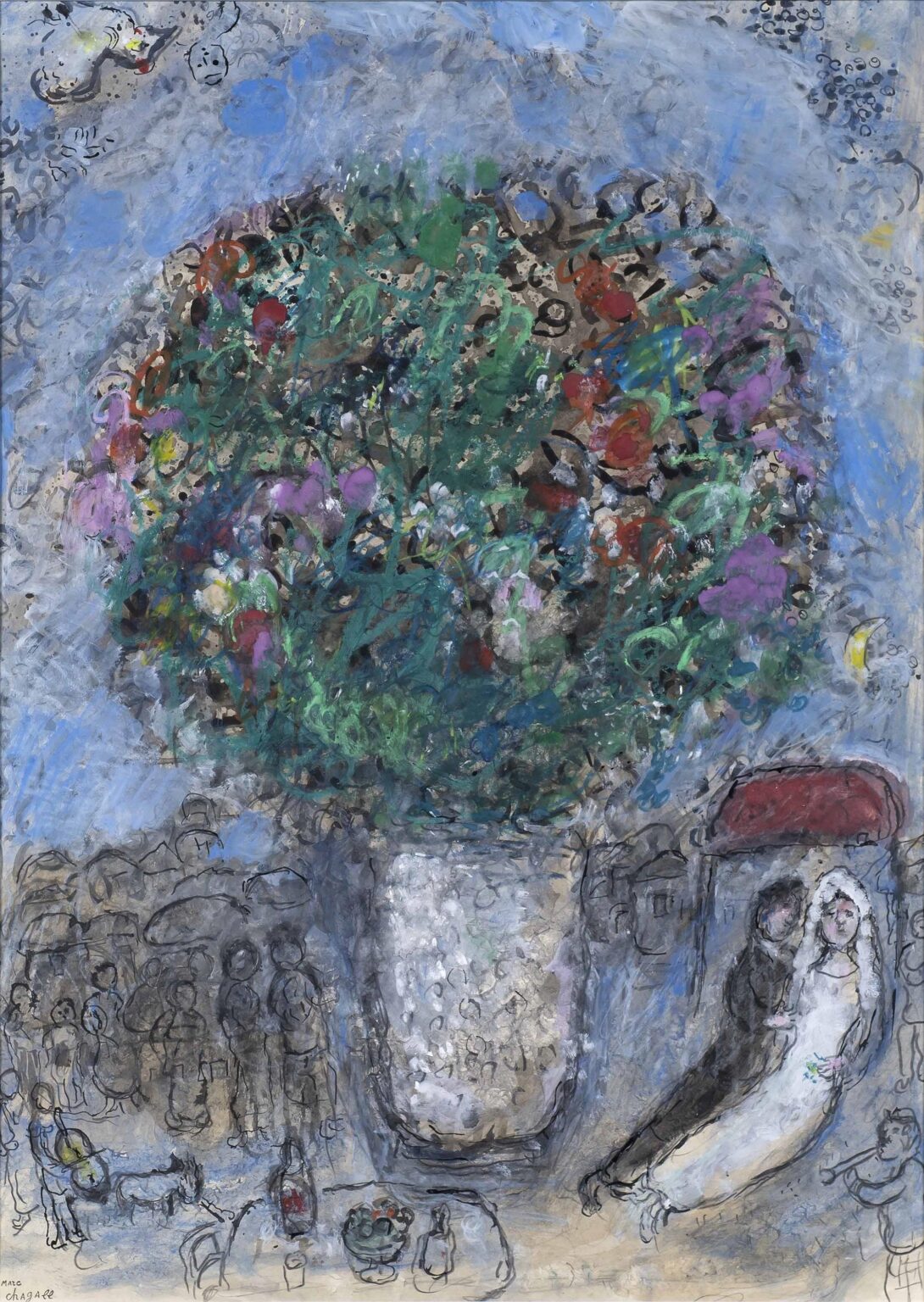
Mariage au grand bouquet is a significant work within the late oeuvre of Marc Chagall, bringing together central themes of his art: love, memory, Jewish tradition and the poetic imagery of his native Vitebsk. As the title suggests, a large bouquet forms the focal point of the composition, which depicts a couple in the midst of a wedding ceremony.
On the right-hand side, bride and bridegroom stand closely together beneath a red chuppah – the canopy central to Jewish wedding rituals, symbolising the home the couple will build together. The pair unmistakably represent Marc Chagall and his first wife, Bella Rosenfeld, whom he married in 1915. Their story began in Vitebsk and culminated in nearly three decades of shared life. Bella’s death in 1944 deeply affected the artist; yet even in his later years he continued to honour her memory in numerous works. The motif of the bridal couple thus functions not only as a religious symbol but also as an expression of personal remembrance and enduring attachment.
The theme further alludes to an episode recounted in Bella’s memoirs. She vividly described witnessing a wedding in her childhood in Vitebsk, recalling the bride as appearing “like a bright cloud […] above all in a long white dress that floated across the ground like something alive, the whole covered by an airy veil. Through it, as through glass, the bride herself seemed far away” (quoted in S. Compton, p. 222). This poetic recollection finds a visual counterpart in Chagall’s pictorial language.
The joyful celebrations of a wedding in Vitebsk are brought to life by a richly laid table with wine and fruit, symbols of abundance and festivity. To the left of the table stands a small donkey – a tender reference to Chagall’s daughter Ida, whom he affectionately called his “little donkey”.
Rendered in shades of grey, the figures of the gathered crowd merge seamlessly into the receding houses, uniting human presence and architecture in a dreamlike whole. The circular heads of the assembled guests reappear as a decorative motif on the white vase, creating a fluid transition from the human to the object world – a realm Chagall mastered with remarkable artistic finesse.
The abundant bouquet, with its violet, yellow, white and red blossoms, integrates harmoniously into the scene and anticipates the floral motifs that characterise many works of his later years. Colour, memory and symbol coalesce in a composition in which personal biography and a universal celebration are inseparably intertwined.
As a work from Chagall’s later period, Mariage au grand bouquet encapsulates essential elements of his visual universe: the evocation of Vitebsk, the celebration of Jewish tradition, the poetic elevation of lived experience and a lifelong homage to Bella.
The painting stands as a compelling example of Chagall’s ability to transform individual memory into a timeless and symbolically charged pictorial language – a defining contribution to 20th-century art.
Tuesdays-Fridays 10 am – 4 pm and by appointment
The gallery remains closed on public holidays.
site managed with ARTBUTLER
To enable us to process your enquiry about this work, please note any special questions or requests you may have.