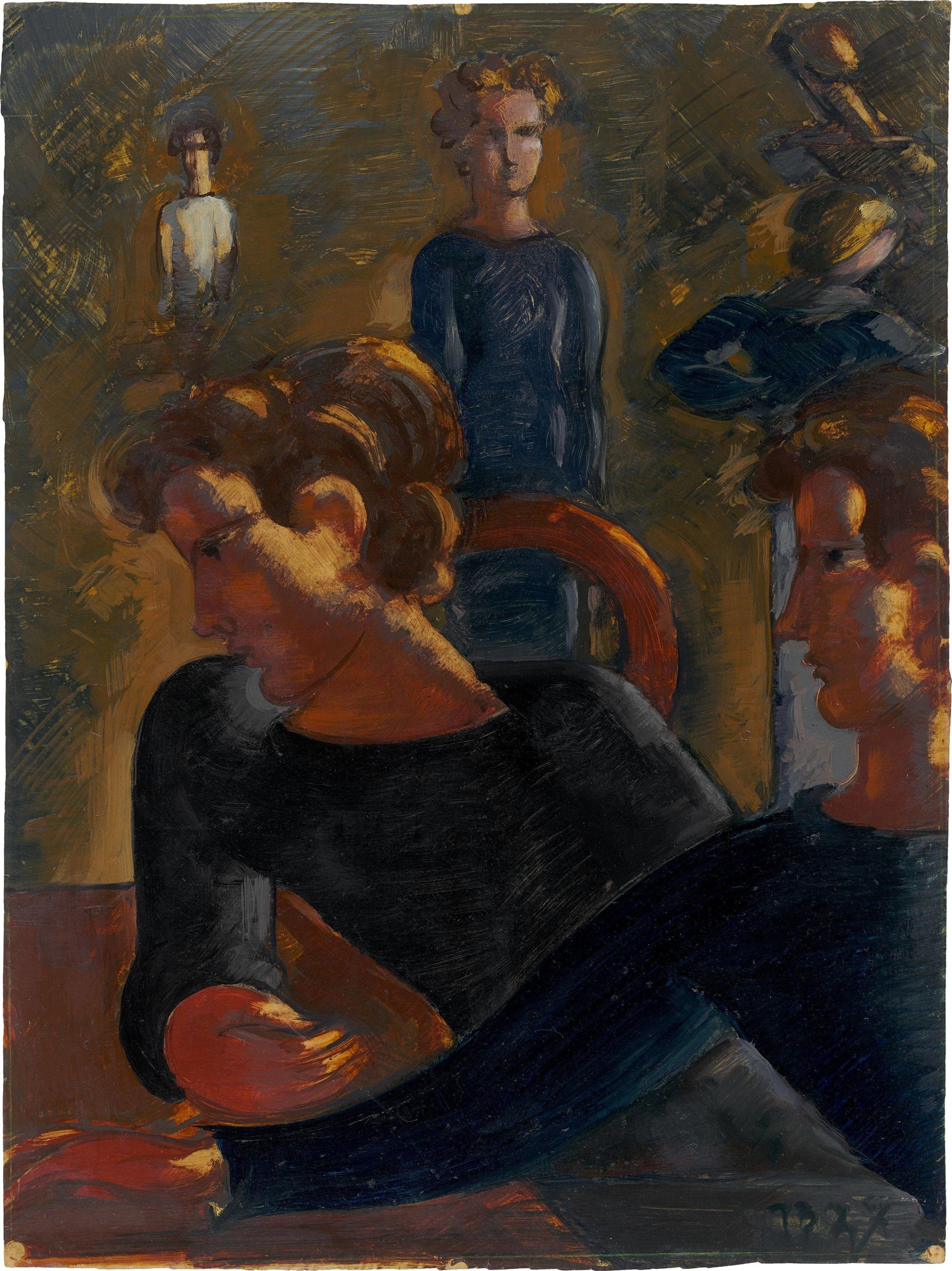
Oskar Schlemmer (* 4 September 1888 in Stuttgart; † 13 April 1943 in Baden-Baden) was one of the most versatile German artists of Classical Modernism. As a painter, draughtsman, sculptor, muralist and stage artist, he was particularly concerned with the relationship between the human figure and space. The human figure, often reduced to geometric forms and represented as a stylised figurine, remained the central theme of his work.
Education and Early Years
Oskar Schlemmer was born in Stuttgart on 4 September 1888. After an apprenticeship in a marquetry workshop, he began studying at the Stuttgart Academy of Fine Arts in 1906. Following a period in Berlin, he continued his studies in Stuttgart and became a master student of Adolf Hölzel in 1912. During these years, Schlemmer increasingly engaged with contemporary developments in the European avant-garde.
At the outbreak of the First World War in 1914, Schlemmer volunteered for military service. After the war, he returned to Stuttgart and resumed his artistic work. In 1919, he exhibited at the “Der Sturm” gallery in Berlin.
The Bauhaus and the Triadic Ballet
In 1920, Schlemmer married Helena Tutein, known as “Tut”. In the same year, he was invited by Walter Gropius to join the Bauhaus in Weimar. There, he assumed various teaching and workshop responsibilities and, from 1923, headed the Bauhaus stage workshop. When the Bauhaus moved to Dessau, Schlemmer continued his teaching there.
In 1922, his Triadic Ballet premiered in Stuttgart, bringing Schlemmer international recognition. His work at the Bauhaus and his involvement with theatre and dance became increasingly important to his artistic practice. At its centre was the relationship between the human figure and the surrounding space. The human figure also remained the dominant subject of his painting. Influenced by Cubism, Schlemmer increasingly developed geometrically structured compositions of figures and space.
Breslau and Berlin
From 1928 to 1930, Schlemmer worked on nine murals for the Museum Folkwang in Essen. In 1929, he left the Bauhaus and accepted an appointment at the Academy of Art and Applied Arts in Breslau. Following its closure, he moved to the United State Schools for Fine and Applied Arts in Berlin in 1932.
After the National Socialists came to power, Schlemmer was dismissed from his teaching position in 1933. His art was denounced as “degenerate”, works were removed from German museums and, in 1937, examples of his work were shown in the Degenerate Art exhibition.
Later Years
In the following years, Schlemmer’s opportunities to work as an artist were severely restricted. For a time, he worked for paint and lacquer companies. During the war years, he worked alongside Willi Baumeister and Georg Muche at the Institute for Painting Materials in Wuppertal. In 1942, during the final period of his career, he created the small-format series of eighteen Window Pictures.
Oskar Schlemmer died in Baden-Baden on 13 April 1943 at the age of 54. His diverse body of work encompasses painting, drawing, sculpture, mural design, dance and theatre, with the relationship between the human figure and space remaining the central theme throughout his artistic career.